JobMaster Storage Comparison
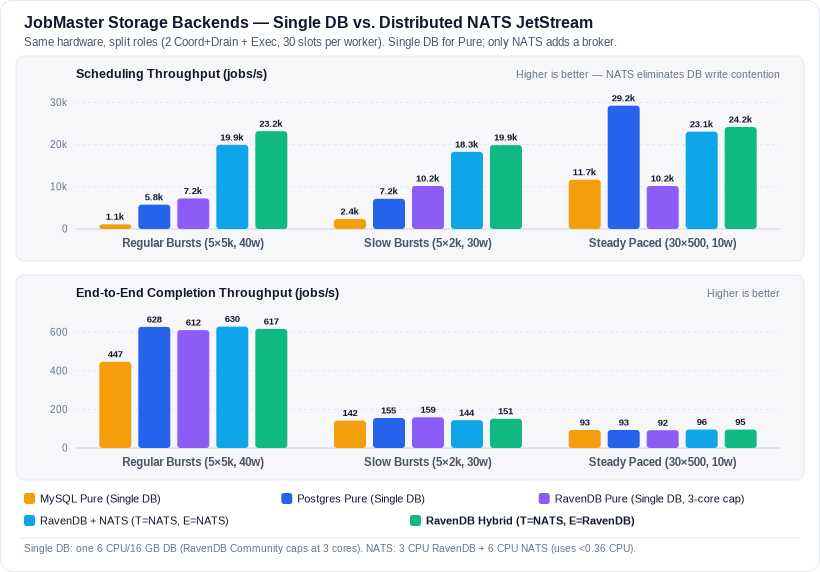
This page compares JobMaster (0.0.12-alpha) across its supported storage providers and distributed NATS JetStream topologies across three workloads: Regular Bursts (5×5k, 40w), Slow Bursts (5×2k, 30w), and Steady Paced Traffic (30×500, 10w).
For the head-to-head comparison against TickerQ, Hangfire, and Quartz.NET on PostgreSQL, see Framework Comparison.
Configuration & Hardware
Every run on this page uses the same worker container resources (2 CPU / 4 GB per worker, --db-pool-size 25, --schedule-concurrency 32) with JobMaster tuned for higher throughput:
- 30 slots per worker (
ParallelismFactor = 6,1 bucket): Opens 30 concurrent execution slots per execution worker so I/O-bound jobs stay saturated without adding extra database bucket polling loops. - Split worker roles (
2 Coordinator+Drain+ remainingExecutioncontainers): Keeps coordination and drain polling on 2 dedicated containers instead of running those loops on all 10–40 workers. - Aligned batch & buffer sizes (
TransferBatchSize = 2000,BucketBufferSize = 4000): Cuts Agent database round-trips and keeps execution slots continuously fed across consecutive bursts.
See the Performance Tuning Guide for how to size ParallelismFactor, BucketQtyConfig, TransferBatchSize, and worker roles for your workload.
Single-Database vs. Distributed Topology
- Single-Database Backends (all on one database server):
PostgresPure,RavenDBPure, andMySqlPureeach run against one6 CPU / 16 GBdatabase container with zero extra messaging infrastructure.- Note: RavenDB Community Edition caps itself internally at 3 CPU cores even inside a 6-CPU container.
- Distributed NATS JetStream Backends (the only multi-service setup): Offloads Agent messaging to NATS JetStream (
6 CPU / 16 GBcontainer, though actual usage stayed under0.36of 1 CPU core) paired with a smaller3 CPU / 8 GBRavenDB master (NATS JetStream works with any supported Master DB: PostgreSQL, MySQL, SQL Server, or RavenDB; RavenDB is used as the Master DB for these runs):RavenDB + NATS(Transport = NATS,Execution = NATS, whereTransporthandlesSavePendingintake andExecutionhandles execution buckets)RavenDB Hybrid(Transport = NATS,Execution = RavenDB, using NATS forSavePendingintake and RavenDB for execution buckets)
Every single run finished with 0 failed schedule requests, 0 lost jobs, and 0 duplicate executions.
Results Across All 3 Workloads
Key takeaways
- RavenDB handles high concurrent execution better than PostgreSQL and MySQL: Under heavy 30–40 worker concurrency (
30 slots per worker), RavenDB sustains high execution throughput (611.5/sat 40w,158.9/sat 30w) without dragging scheduling throughput down as sharply as PostgreSQL or MySQL. Even under its 3-core Community cap, single-nodeRavenDBPureoutperformed 6-CPUPostgresPureandMySqlPureon burst scheduling (7,245/svs5,754/sand1,115/sat 40w;10,182/svs7,166/sand2,370/sat 30w) at half of PostgreSQL's DB CPU (202.9%vs404.5%). - Single-DB steady traffic (Paced): PostgreSQL leads. With less concurrent write contention across 10 workers,
PostgresPurehits29,231/s(12 msp50, peak43.5k/s) at48.9%DB CPU. - Single-DB MySQL (
MySqlPure): Runs cleanly (0lost/dup) and achieves447/sE2E at 40w and11,657/sscheduling on paced traffic, making it a practical option when MySQL is already your standard database, though heavier on DB CPU (526.8%at 40w) under intense bursts. - Distributed NATS JetStream eliminates the 40-worker scheduling drop-off: Moving Transport off the database onto NATS JetStream jumps 40-worker burst scheduling by 4× over single Postgres (
23,172/svs5,754/s,177 msp50) while maintaining~618–630/sE2E completion and consuming only2.47combined backend CPU cores (211.5%RavenDB +35.2%NATS). - Hybrid (
T=NATS, E=RavenDB) vs. Full NATS (T=NATS, E=NATS): Keeping transport on NATS and execution persistence on RavenDB outperformed fullRavenDB + NATSon scheduling across all 3 scenarios (23,172/s,19,886/s,24,187/s), while pureRavenDB + NATSdelivered slightly tighter E2E at 40w (39.7 s,11.7 sp50,19.0 sp99). - Tiny NATS footprint: Across all 3 workloads, NATS JetStream stayed below 0.36 of a single CPU core (
35.2%at 40w bursts,9.3%at 30w slow jobs,3.7%on steady paced traffic).
Detailed Metrics
Full tables (p50/p99 latency, request latency, DB CPU, NATS CPU, and worker CPU) are included directly in this documentation: